
For any U.S. tech professional, particularly those from the fast-paced environment of the West Coast, the idea of working in Japan often conjures a conflicting set of images. On one hand, there's the allure of a society renowned for its safety, unparalleled public transportation, and rich cultural tapestry. On the other, there's the persistent, ominous stereotype of "karoshi"—death from overwork—and tales of grueling, endless hours chained to a desk.
The online narrative is potent. A quick search reveals horror stories that would make any Silicon Valley engineer, accustomed to catered lunches and flexible hours, think twice. Yet, the hard data tells a surprisingly different story. According to the Organisation for Economic Co-operation and Development (OECD), the average employee in Japan actually worked 1,607 hours in a year, significantly fewer than the 1,791 hours logged by their American counterparts.
This statistical contradiction lies at the heart of the confusion for many U.S. engineers considering a move. How can a country with a reputation for overwork officially have shorter working hours than the U.S.? Is the dream of a healthy work-life balance in Japan's vibrant tech industry a realistic goal or a dangerous fantasy?
This article cuts through the noise. By combining official government statistics, data from reputable international organizations, and—most importantly—the unfiltered, on-the-ground experiences of foreign engineers working in Japan today, we will deconstruct what "work-life balance" truly means in the Japanese tech sector. We will explore the vast differences between company types, the cultural nuances that statistics don't capture, and provide a practical guide for U.S. engineers looking to find a role in Japan that offers not just a job, but a life.
What "Work-Life Balance" Actually Looks Like in Japan's Tech Industry
The most critical factor in understanding work-life balance in Japan is recognizing that the term itself is misleading—it varies dramatically depending on context. The experience of a software engineer in Japan is not uniform; it is profoundly shaped by the type of company they join. The distinction between a traditional Japanese corporation, a modern domestic startup, and a foreign multinational operating in Tokyo is not just a minor detail—it is the primary determinant of your work culture, hours, and overall quality of life.
One Reddit user from the r/JapanJobs community, Altruistic-Mammoth, succinctly captured this reality: "Question is kind of meaningless as obviously not all software engineering jobs in Japan are equal. They range from FAANG, FAANG-like, FAANG-wannabe, multinational hedge funds, startups, crappy Japanese companies. Salaries and work culture also obviously vary by company as well."
This sentiment is echoed across countless forums and discussions. The consensus is clear: if you want a Western-style work-life balance, you should work for a Western company in Japan. Another user emphasized this point directly: "You want to live in Japan..... but work for a foreign company. Working for a Japanese company is something I never want to do again. 1/10 stars for Japanese employment ....don't recommend."
While some engineers report incredibly positive experiences with minimal overtime, others recount tales of extreme pressure and inefficiency. One user on r/cscareerquestions described an almost utopian work-life balance: "Work life balance? Not nearly as bad as people are making it to be here. I do a good 30mins of overtime per MONTH. Usually I start on time, finish on the exact minute. Work from home, every day of the week."
Conversely, a former employee of a traditional Japanese translation firm shared a harrowing experience: "I was let go after 2 years because I was only working 10-12 hours a day rather than the 14-16 everyone else was putting in... There were people working 19 hour days successively. Like, only going home for 4-6 hours of sleep and a quick shower. For days on end. Saturdays too."
These wildly different experiences highlight the three main categories of tech employers in Japan:
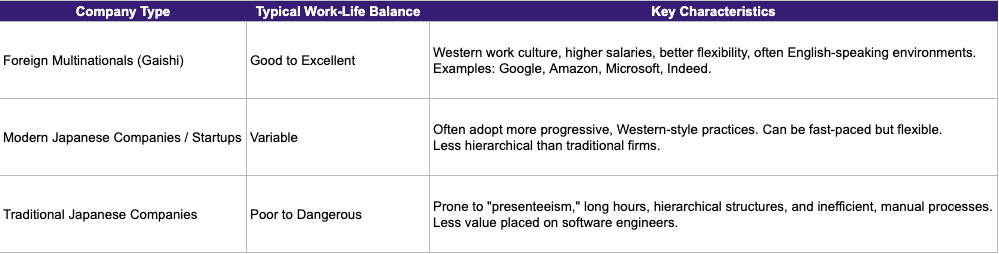
For a U.S. engineer, targeting a foreign multinational or a well-funded, modern Japanese startup with an international team is the most reliable path to achieving a healthy work-life balance.
Hard Data: Working Hours in Japan Tech (Compared to U.S. Tech)
While personal anecdotes paint a vivid picture, it is the hard data that reveals the broader trends in working hours. As mentioned, the top-level OECD statistics present a counter-intuitive reality: the average American works more hours per year than the average Japanese worker. In the most recent data, the U.S. clocked in at 1,791 hours per year, while Japan recorded 1,607 hours.
However, this data point, while accurate, can be misleading if taken at face value. The real story of work-life balance in Japan is found in the details of how those hours are worked, reported, and culturally perceived.
The Overtime Reality: Paid, Unpaid, and Deemed Japan's Ministry of Health, Labour and Welfare (MHLW) has been actively trying to curb the country's notorious overtime culture. The "Work Style Reform Act" of 2018 established legal caps on overtime, generally limiting it to 45 hours per month and 360 hours per year. While special agreements can extend this, the law represents a significant step towards change.
Despite these efforts, the issue of unpaid overtime, known as sabisu zangyo ("service overtime"), persists. A government survey found that approximately one in ten Japanese employees work over 80 hours of overtime per month, and one in five faces the risk of karoshi [1]. This highlights a grim reality that official averages can obscure.
Furthermore, many Japanese companies utilize a system where a certain amount of overtime is pre-calculated into the monthly salary. A Reddit user explained this structure:
"Overtime isn't unpaid in Japan, but it is paid along with your base salary. So a Japanese contract may look like this in which they will pay you for the standard 160 hours a month and 40 hours of overtime at 250k JPY a month. You do not need to work the overtime and still get 250k JPY. However, some managers demand that you work at least 20 hours of overtime in a month since you are already being paid."
This system can create pressure to work unnecessary hours simply because they are already compensated.
The Culture of Presenteeism One of the most pervasive issues in traditional Japanese workplaces is presenteeism—the practice of being physically present at the office regardless of productivity. This culture values face time over actual output, leading to employees staying late not because they have work to do, but because leaving before the boss is seen as a lack of commitment.
A user on r/JapanJobs described this phenomenon: "The biggest issue is that in traditional Japanese companies, your value isn't measured by output but by hours in the office. You could finish all your work by 3 PM, but if you leave before 8 PM, you're seen as lazy."
This culture is gradually changing, particularly in tech companies and startups that have adopted more results-oriented approaches. The COVID-19 pandemic accelerated this shift, with remote work forcing companies to focus on output rather than presence.
Remote Work Revolution The pandemic has been a catalyst for change in Japan's work culture. According to a BLOOM TECH Career report, remote work adoption in Japan jumped from just 13.2% pre-pandemic to over 35% in 2023. Tech companies have been at the forefront of this change, with many maintaining flexible work arrangements even as other sectors returned to the office.
However, the extent of remote work varies dramatically by company type:
- Foreign Companies: Often maintain global remote-first or hybrid policies
- Modern Japanese Tech Companies: Typically offer 2-3 days remote per week
- Traditional Japanese Companies: Many have returned to full in-office requirements
Red Flag vs. Green Flag Companies
Based on extensive community feedback, certain patterns emerge that can help U.S. engineers identify companies likely to offer good work-life balance versus those to avoid.
Green Flags:
- English as the primary working language
- International team composition (>30% foreign employees)
- Transparent discussion of work hours during interviews
- Clear performance metrics based on output, not hours
- Flexible work arrangements prominently featured in job descriptions
- Modern tech stack and engineering practices
- Leadership with international experience
Red Flags:
- Vague descriptions of work culture using terms like "family atmosphere"
- Emphasis on "dedication" and "commitment" over skills
- Reluctance to discuss specific work hours or overtime policies
- All-Japanese leadership team with no international experience
- Outdated technology stack or heavy reliance on manual processes
- Office located in traditional business districts rather than tech hubs
- Salary structure with large "deemed overtime" component
Direct Comparison: U.S. Tech vs. Japan Tech Work-Life Balance
To provide a clear picture, here's a detailed comparison across key work-life balance factors:
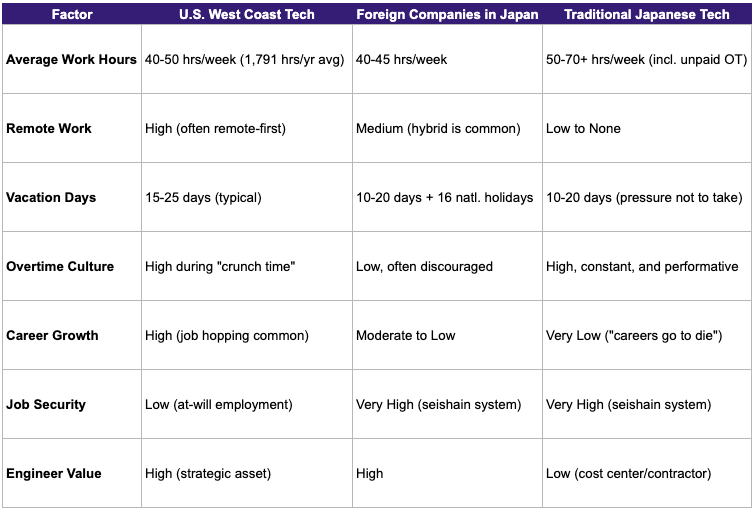
This comparison makes the choice clear: for a U.S. engineer, the work-life balance experience in a foreign company in Tokyo can be comparable to, or even better than, that of the U.S. West Coast, especially when factoring in higher job security and a lower cost of living. Conversely, a role in a traditional Japanese company presents a high risk of a poor work-life balance, limited career growth, and cultural friction.
Which Japan Tech Companies Offer the Best Work-Life Balance?
Based on community feedback and industry reputation, certain companies consistently emerge as providing the best work environments for foreign engineers in Japan. These generally fall into three categories:
1. FAANG and Major U.S. Tech Companies: Google, Amazon, Microsoft, Meta, and Indeed are frequently cited as offering the best combination of Western work culture, competitive salaries, and good work-life balance. They operate largely as extensions of their U.S. counterparts.
2. Global Financial Firms: Multinational investment banks and hedge funds (e.g., Nomura, Goldman Sachs) are known for their high-paying, high-performance environments. While the work can be demanding, they are typically results-oriented and free from the inefficiencies of traditional Japanese firms.
3. Modern, International Japanese Companies: Companies like Rakuten (specifically its global teams), Mercari, and Toyota's Woven Planet project are often recommended as Japanese firms that have successfully adopted a more global, progressive work culture.
Real Stories: U.S. Engineers Who Moved to Japan
The experiences of those who have made the move provide the most compelling insights. The stories range from idyllic to nightmarish, reinforcing the central theme that company choice is everything.
The Positive Experience: One user on r/cscareerquestions, who claimed to have an excellent work-life balance, also highlighted the quality of life benefits outside of work:
"Rent is alright, I pay €1,500 a month for a 45sqm apartment, brand new. This includes all costs such as electricity and water, internet."
This, combined with Japan's safety, food culture, and public services, can create an overall life experience that is hard to match in the U.S., even with a lower salary. The Negative Experience: A starkly different perspective comes from those who have worked in traditional environments:
"If your priority is your private life, stay in Germany. I tried both. Working and living in Japan (Tokyo) is stressful."
This user's experience underscores the risk of burnout in the wrong company, where the cultural pressures can negate the benefits of living in Japan.

Practical Checklist: How U.S. Engineers Can Find Work-Life Balance Jobs in Japan
For engineers ready to explore opportunities, a strategic approach to the job search is essential.
During the Interview Process:
- Ask Direct Questions: Inquire specifically about average overtime hours, remote work policies, and how the company measures performance.
- Probe on Culture: Ask about the communication style, the decision-making process (nemawashi), and the role of meetings.
- Observe the Interviewers: Are they energetic and passionate, or do they seem tired and overworked? Their condition is a strong signal of the company culture.
Researching Companies:
- Use Review Sites: Glassdoor and OpenWork (a Japanese-language review site, accessible with translation tools) are invaluable resources.
- Network on LinkedIn: Reach out to current or former foreign employees at the company and politely ask about their experience.
- Check for International DNA: Does the company have a global presence? Is its leadership team diverse? These are good indicators of a more progressive culture.
Reviewing the Contract:
- Understand the Salary Structure: Clarify the base salary versus the bonus and deemed overtime components.
- Get Policies in Writing: Ensure that any agreements regarding remote work or flexible hours are clearly stated in the employment contract.
Conclusion: Is Japan Tech Worth It for Work-Life Balance?
So, is Japan a viable destination for a U.S. engineer concerned about work-life balance? The answer is a resounding yes, but with a major caveat.
The dream of a fulfilling career in Japan combined with an excellent quality of life is not only possible but is a reality for many foreign engineers. However, this outcome is not a matter of luck; it is the result of careful, strategic decision-making.
The path to a good work-life balance in Japan's tech industry runs almost exclusively through foreign multinational companies and modern, internationally-minded Japanese firms. For those willing to do their research, ask the tough questions, and selectively target the right employers, Japan offers a unique proposition: a safe, vibrant, and culturally rich lifestyle, supported by a stable and respectful work environment that can, in the right circumstances, be far less stressful than the high-stakes churn of Silicon Valley.
For those who prioritize career advancement and salary above all else, the U.S. likely remains the better option. But for those seeking a different balance—one that weighs quality of life, safety, and cultural experience alongside professional satisfaction—Japan's tech scene holds a world of opportunity.
References
- 4dayweek.io, "Japan Work-Life Balance: Is the Culture Finally Changing?", https://4dayweek.io/work-life-balance/japan
- Reddit, r/JapanJobs, "Japan working culture", https://www.reddit.com/r/JapanJobs/comments/1ljcto8/japan_working_culture/
- Reddit, r/cscareerquestions, "How is life as a SWE in Tokyo?", https://www.reddit.com/r/cscareerquestions/comments/wlx037/how_is_life_as_a_swe_in_tokyo/
- Ministry of Health, Labour and Welfare, Japan, "Work Style Reform Act" (2018)
- BLOOM TECH Career, "Remote Work in Japan: Trends, Tools, and Success Strategies", https://global.bloomtechcareer.com/media/contents/remote-work-in-japan-trends-tools-and-success-strategies/